
Franchise Buyer Persona Profile: The Immigrant and E-2 Franchise Investor
This article is part of a broader series that explores the 15 franchise buyer personas shaping today’s franchise development landscape. Each persona represents a distinct segment of candidates defined by background, motivations, and decision behavior that franchisors must understand in order to attract and support the right owners.
In this installment, we take a deep dive into the immigrant and visa‑motivated franchise investor, known as the Immigrant/E-2 Visa Persona. This persona includes candidates pursuing E‑2, L‑1, and related pathways who view franchise ownership as both a business investment and an immigration strategy.
Many arrive with established careers or businesses in their home countries, strong savings, and a clear focus on creating stability and opportunity for their families through business ownership in the United States.
Here we will examine the demographic profile, financial capacity, motivations, pain points, and preferred franchise models that define this group. We will also look at how they evaluate timelines, what they expect from a franchise system, and why immigration risk and unit economics sit at the center of their decision process. Finally, we will outline practical marketing strategies and messaging approaches that help franchisors connect with and convert this high‑intent but highly cautious buyer persona.
Who Is the Immigrant/E-2 Visa Franchise Investor?
The immigrant and visa‑motivated franchise investor persona represents individuals who pursue franchise ownership as a structured, lower‑risk path into the U.S. economy and, in many cases, into U.S. residency. Many fall under E‑2 treaty investor, L‑1A intracompany transfer, or similar categories and combine business objectives with immigration planning.
These candidates are typically mid‑career professionals or business owners with strong savings and six‑figure liquid capital available for investment. They are not experimenting casually with entrepreneurship. Instead, they are making a deliberate, high‑stakes decision that will affect legal status, income, and family trajectory.
Demographic and Background Profile
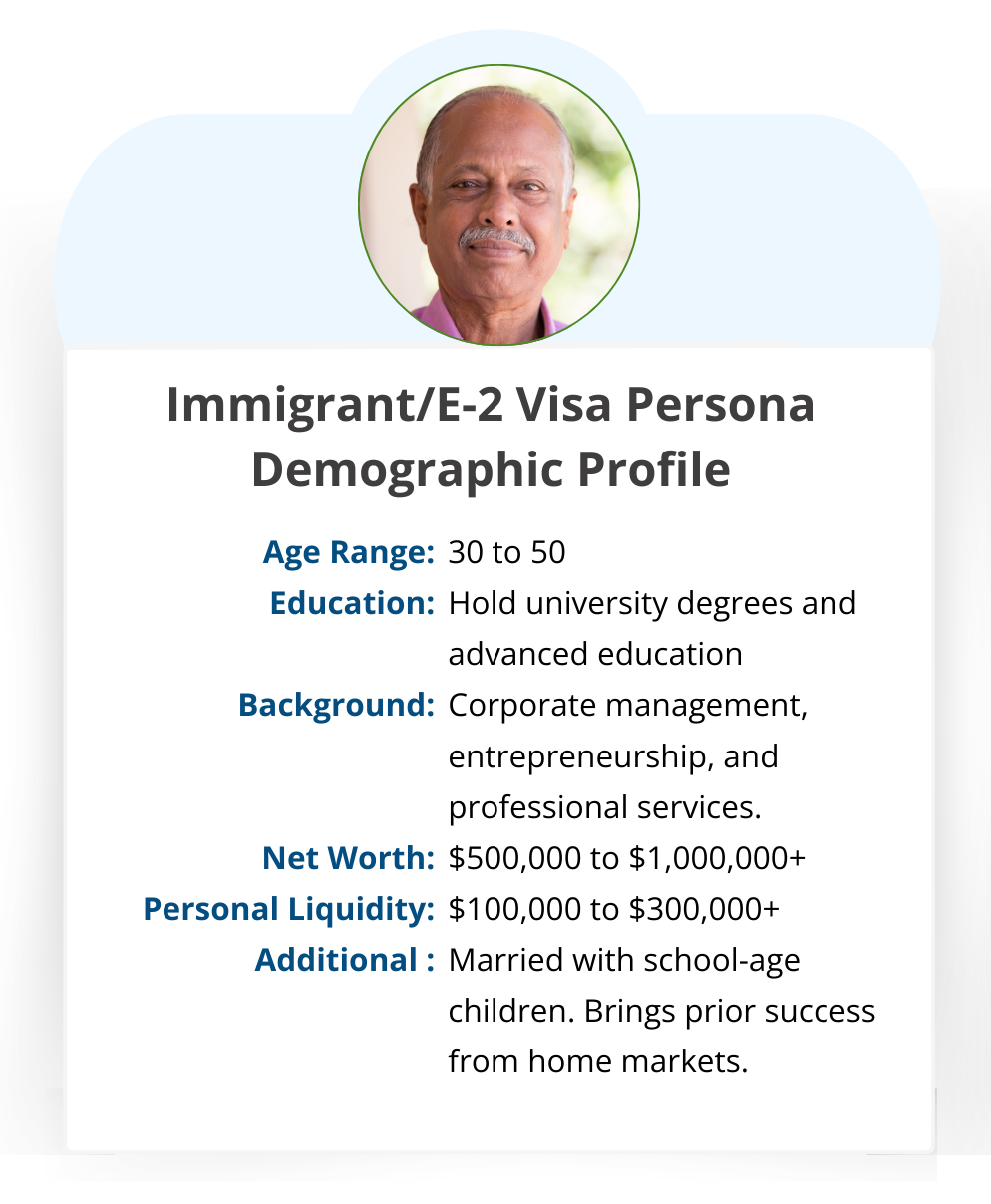
This persona shares several consistent demographic and professional traits. Understanding these helps franchisors calibrate expectations around sophistication, risk tolerance, and support needs.
Most immigrant and visa‑motivated franchise investors:
Fall in the 30s to 50s age range and are often married with school‑age or college‑age children.
Come from treaty or qualifying countries and relocate to major metropolitan areas or fast‑growing suburbs, often choosing regions with established immigrant communities such as Texas, Florida, Georgia, California, and Illinois.
Hold university degrees. Many have advanced education in fields such as engineering, information technology, finance, medicine, or business management.
Bring prior success in their home markets. Backgrounds include corporate management, entrepreneurship, and professional services.
Within that broad picture, several professional sub‑segments appear frequently. These include:
Corporate managers and executives who qualify for L‑1A transfers and want to operate a U.S. franchise entity as part of an intracompany expansion.
Owners of small to mid‑sized companies abroad seeking to expand into the U.S. through an L‑1 structure or as serial entrepreneurs choosing E‑2‑friendly franchises.
Professionals from consulting, technology, finance, and skilled trades who want a more controllable income path that also supports an immigration objective.
Financially, this persona is usually well capitalized. For single‑unit buyers, net worth often sits in the mid‑six to low‑seven figure range, while multi‑unit portfolio investors may fall into the seven‑ to eight‑figure range. Liquidity for the first franchise investment typically sits between $100,000 and $300,000, with some investors planning to deploy $500,000 to $1,500,000 over time as they scale.
Psychographically, the immigrant and visa‑motivated investor is highly family‑oriented and long‑term in outlook. They are focused on safety, education, and community for their children and see the franchise as part of a broader life transition rather than a narrow financial trade.
How Much Do They Invest? How Do They Think About Capital?
Capital readiness is central to this persona. Visa categories such as E‑2 and L‑1 require evidence of substantial investment and a non‑marginal enterprise, so investors pay close attention to both amount and deployment of funds.
Typical Investment Ranges
While regulations do not specify a precise minimum, market patterns and immigration practice create informal investment bands. For many E‑2 and similar candidates, these bands look like the following.
Professional and consulting style service concepts often require $80,000 to $120,000 in total investment, which can include initial fees and working capital.
Light retail or e‑commerce models commonly start in the $100,000 to $150,000 range.
Food service, quick‑service restaurants, and many mainstream bricks‑and‑mortar franchises often require $150,000 to $300,000 or more.
Multi‑unit and portfolio strategies, pursued by more experienced or ROI‑driven investors, can reach $1,000,000 to $1,500,000 deployed over a decade.
A practical working assumption for many franchisors is that this persona holds around $100,000 to $300,000 in liquid funds for an initial unit and can sometimes stretch to $400,000 through partners or home‑country financing.
Attitude Toward Debt and Risk
These investors tend to be cautious about leverage. Many prefer substantial equity injection both to strengthen visa petitions and to manage personal risk in an unfamiliar financial system. Limited U.S. credit history and uncertainty regarding lender attitudes toward visa‑dependent businesses also shape this cautious stance.
Consequently, franchisors should expect a high level of attention to:
Return on investment
Breakeven timelines
Working capital requirements
Clear financial frameworks and realistic modeling are more persuasive than overly optimistic projections.
What Motivates the Immigrant/E-2 Persona to Buy?
Motivations for this persona combine immigration, economics, and family aspirations. These motivations drive both the appeal of franchising and the specific ways candidates compare brands, structures, and timelines.
Several core drivers appear consistently. Together, they create a decision lens that is distinct from purely domestic or purely lifestyle‑driven buyers.
Key motivations include the following.
Immigration and legal status. Candidates want a reliable, documented way to live and work in the United States. E‑2 and L‑1 structures, or related visa categories, are central to their planning and create strong interest in brands with a track record of visa approvals.
Stability and control. Franchising is perceived as more predictable than launching a brand‑new concept in a new country. Proven systems and support mitigate perceived risk compared with independent start‑ups.
Risk‑adjusted wealth creation. Investors seek better upside than a salaried job but want guardrails around execution. Brand, playbook, training, and peer networks help them pursue growth without assuming unstructured risk.
Legacy and family advancement. Many intend to employ family members, fund education, and create multi‑generational wealth. The business is framed as a family platform, not just a personal project.
Efficient entry into a new market. Franchise systems provide pre‑built marketing, supply chains, and operational processes. This speed matters in the context of visa timelines and financial burn rates.
Compared with some other personas, “be your own boss” is less central for this group. Security, structure, and the ability to link business ownership with immigration and family goals carry more weight.
What Types of Franchises Draw Immigrant/E-2 Buyers?
Franchise selection for this persona centers on operational simplicity, visa compatibility, and predictable demand. Candidates want concepts that can be clearly explained to consular officers and supported with straightforward financial and job‑creation narratives.
Several categories stand out.
Service and home‑based franchises. Cleaning, maintenance, restoration, B2B services, consulting, and other light professional services are attractive. These models often have lower fixed costs, simpler staffing requirements, and faster paths to cash flow.
Senior care and healthcare‑adjacent brands. Aging demographics and consistent demand make senior care and related services appealing. Many resources highlight these as strong options for E‑2 investors because of perceived recession resistance and clear employment impact.
Essential consumer services. Shipping and parcel centers, phone repair shops, basic retail, and automotive services attract interest. These services exist in most communities and are easy to describe in business plans and visa applications.
Food and quick‑service concepts. Recognizable restaurant brands remain popular, particularly among higher‑capital investors or those with hospitality backgrounds. However, candidates are wary of higher capital expenditure, longer hours, and intensive labor management.
Explicitly “E‑2 friendly” or visa‑oriented franchises. Brands and brokers that position themselves as visa‑friendly, highlight past investor approvals, and provide immigration‑ready documentation capture disproportionate attention from this persona.
In practice, many immigrant and visa‑motivated investors favor lean, essential, and clearly structured businesses, particularly when they are entering the U.S. market for the first time.
What Pain Points and Challenges Do They Face?
Despite their experience and capital, immigrant and visa‑motivated franchise investors face several unique pain points. These are rooted in immigration complexity, limited local networks, and the realities of operating in a new market.
These challenges influence how quickly they move, how much reassurance they require, and how they evaluate franchisor credibility.
Key pain points include the following:
Regulatory and visa uncertainty. Many candidates are confused about what qualifies as a substantial investment, how to avoid “marginal” business classifications, and how to time investment relative to visa approval. The risk of denial or policy changes amplifies anxiety.
Information asymmetry and trust gaps. Limited U.S. networks make it harder to verify statements from franchisors, brokers, and service providers. Candidates are wary of overly optimistic claims and want unbiased validation.
Limited familiarity with the U.S. market. Learning local consumer preferences, employment laws, tax requirements, and licensing rules while also adapting to a new culture can feel overwhelming.
Financing friction. Thin U.S. credit files and visa‑dependent status constrain access to SBA loans and traditional bank financing. Some lenders are cautious about businesses that depend on non‑permanent visas.
Family risk and emotional pressure. Candidates feel they are placing their family’s future on the line with a single decision. Concerns about children’s adjustment and the possibility of needing to leave the country if the business fails are common.
Operational overwhelm. Managing employees, HR compliance, and marketing in a new regulatory and cultural environment generates ongoing stress, even in supportive franchise systems.
Franchisors who acknowledge these challenges openly and provide structured solutions often differentiate themselves in this segment.
What Financial Concerns Block Immigrant Investors?
Many immigrant and visa‑motivated buyers approach franchise investment with a portfolio mindset. They balance potential returns against immigration outcomes, capital preservation, and opportunity costs. Several financial concerns can slow or halt their decision.
The most common barriers include the following.
Unclear or weak unit economics. When disclosure documents, presentations, or validation calls do not provide clear ranges for earnings, margins, or payback periods, investors often step back.
Fear of a marginal business. Candidates worry that the business may function only as a self‑employment platform, which could fail both their income needs and E‑2 requirements for non‑marginality.
Coupling of downside risk and visa risk. If a franchise underperforms, investors may lose capital and potentially jeopardize their status in the U.S. This stacked risk profile is a powerful deterrent.
High investment relative to achievable earnings. All‑in investments of $150,000 to $300,000 that produce projected owner incomes of $50,000 to $90,000 can appear less attractive than other uses of capital.
Limited visibility into exit options. Lack of data on resales, historical multiples, or buyer demand for existing units makes it hard for investors to model downside protection or eventual equity realization.
Dependence on franchisor performance. Investors worry that even if they execute well, a weak brand strategy, poor marketing, or operational missteps at the system level could undermine returns.
Addressing these concerns requires transparent data, clear communication about risk, and realistic expectations around revenue and timeline.
What Messaging and Content Does This Persona Trust?

Visa‑motivated immigrant investors respond to content that is concrete, specific, and clearly informed by immigration realities. They are generally skeptical of hype and prefer detailed, practical information.
Several themes and formats consistently resonate. High‑impact messaging themes include the following.
A structured pathway to U.S. residency and business ownership. Candidates want to see direct references to E‑2, L‑1, and similar processes, as well as clear indications that the brand has experience with these paths.
Proven, non‑marginal business models with real job creation. Messaging that highlights staffing plans, expected headcount, and multi‑year growth trajectories speaks both to visa adjudicators and investor priorities.
Transparent investment and performance expectations. Detailed startup budgets, working capital assumptions, and realistic revenue ramp timelines build credibility.
Assurance that they are not alone. Explicit emphasis on training, ongoing support, and peer communities helps counter feelings of isolation and reduces perceived execution risk.
Data‑driven decision support. Market analysis, trade area demographics, traffic data, and comparative performance benchmarking appeal to analytical investors.
Content formats that perform well for this persona include the following.
Visa‑oriented guides and checklists that explain how to structure an E‑2 or L‑1‑based franchise investment, often including example budgets and timelines.
Case studies of immigrant franchisees that highlight pre‑U.S. background, funding structure, time to visa approval, and first‑year performance.
Webinars and long‑form Q&A sessions featuring both franchisor representatives and immigration attorneys, which allow detailed questions on structure and risk.
Sample business plans and financial models that align with immigration requirements, including five‑year projections, hiring plans, and marketing frameworks.
When messaging is specific, transparent, and grounded in real examples, this persona is more willing to advance through the development funnel.
How Should Franchisors Reach and Engage This Persona?
Successful outreach to immigrant and visa‑motivated investors depends on partnerships, trust‑building, and sensitivity to geography and time zones. It also requires channels that reach candidates before or during their early immigration planning.
Effective strategies include the following.
Building relationships within the immigration ecosystem. Co‑marketing with immigration attorneys, business plan consultants, relocation specialists, and international tax advisors positions the brand where candidates seek trusted guidance.
Leveraging international broker networks and franchise portals. Portals and consulting groups that curate visa‑friendly franchise options serve as key discovery channels for these buyers.
Engaging ethnic and diaspora communities. Participation in diaspora business associations, community chambers of commerce, and culturally specific online groups helps franchisors reach networks where peer recommendations carry strong weight.
Adopting a high‑touch, consultative sales process. Multi‑step education journeys, one‑on‑one strategy sessions, and individualized financial modeling are more effective than short, generic discovery calls.
Offering time‑zone aware communication channels. Many candidates still live abroad during early exploration. Webinars at varied times, recorded sessions, and communication tools such as WhatsApp or WeChat support engagement.
Franchisors who approach this persona as a long‑cycle, advisory relationship rather than a quick close typically see stronger conversion and satisfaction.
How Quickly Do Immigrant/E-2 Investors Commit?
Decision timelines for this persona are shaped by both business diligence and immigration processes. As a result, the path from initial interest to operational launch often extends longer than for domestic buyers who are not managing visa requirements.
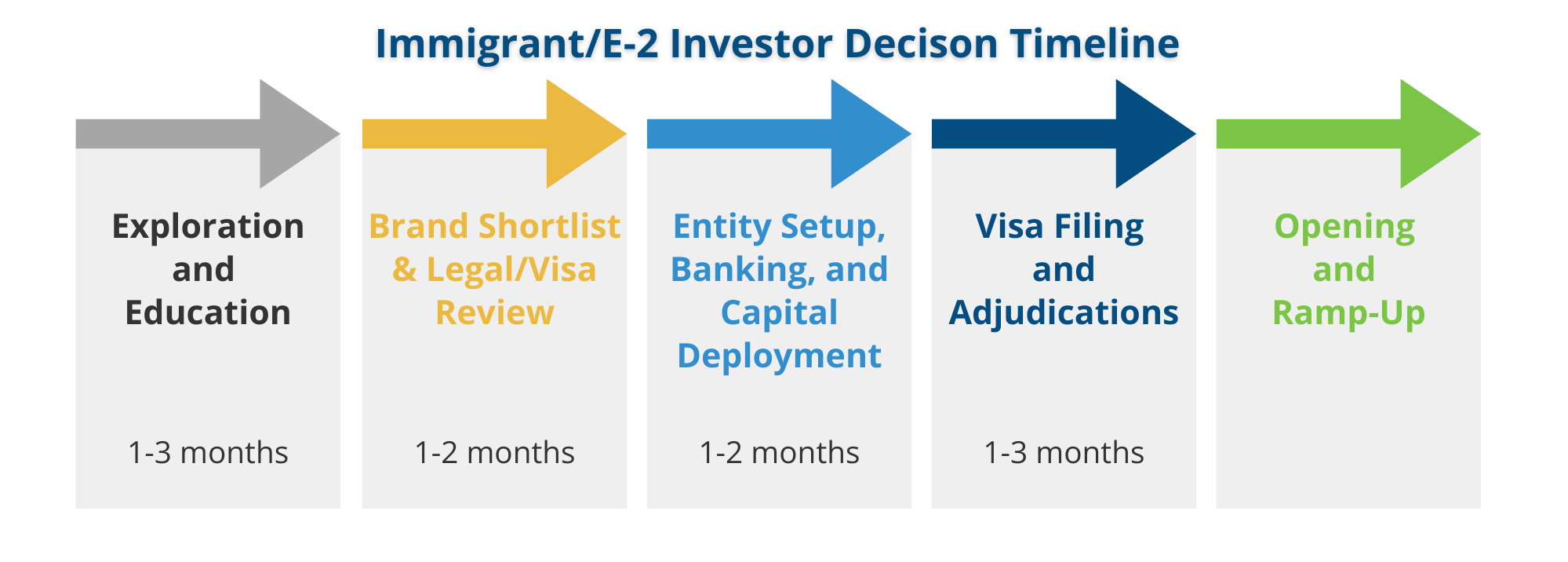
A typical sequence includes several stages.
Exploration and education.
Over approximately one to three months, candidates attend webinars, read guides, and conduct initial calls with brokers, attorneys, and franchisors to understand visa options and business models.Brand shortlisting and legal review.
During the next one to two months, candidates review FDDs, speak with existing franchisees, and work with counsel to confirm visa fit and business structure.Capital movement and entity formation.
Another one to two months may be required to form U.S. entities, open bank accounts, transfer funds, and sign franchise agreements or leases.Visa filing and adjudication.
The final stage, from application to decision, often takes one to three months, depending on category and consular processing times.
Altogether, visa‑linked franchise investments often follow a four‑ to nine‑month decision and launch cycle, with shorter timelines possible for highly prepared or already present L‑1 candidates.
What Solutions Help Overcome Doubts and Hesitations?
Because this persona faces intertwined immigration, financial, and operational risks, franchisors must provide more than standard franchise sales materials. They must deliver targeted solutions that address the most pressing doubts head‑on.
Several approaches have proven effective in reducing friction and building confidence.
Visa risk mitigation.
Providing attorney‑vetted structures, sample approval packages, and immigration‑ready business plans reassures candidates that the franchise concept aligns with E‑2 and L‑1 adjudication standards.Financial clarity and stress testing.
Offering best‑case, base‑case, and worst‑case models, along with clear breakeven analysis and working capital runway, helps investors understand the practical downside and plan accordingly.Operational support and localization.
Strong onboarding, local marketing playbooks, and hiring support demonstrate that the franchisor understands the extra burden of operating in a new country.Community and mentorship.
Formal mentoring that pairs new immigrant owners with experienced franchisees, especially those with similar backgrounds, provides both practical guidance and emotional reassurance.Exit and contingency planning.
Open discussion of resale pathways, historical exit data, and options for restructuring underperforming units helps investors plan for downside scenarios rather than fear them in silence.Family‑centric positioning.
Content that addresses education, safety, and long‑term stability acknowledges the central role of family in these decisions and positions the brand as a partner in that broader life plan.
By combining immigration‑savvy support with rigorous financial transparency and strong community structures, franchisors can create a compelling value proposition for immigrant and visa‑motivated franchise investors.
What’s Up Next?
Taken together, these insights show that the Immigrant/E‑2 Visa Franchise Investor is a highly capable, well‑capitalized, and family‑driven buyer who treats franchising as both an entrepreneurial move and a strategic immigration vehicle. By recognizing their unique mix of immigration risk, financial scrutiny, and operational challenges, franchisors can design smarter education, support, and deal structures that build trust instead of adding friction. Brands that bring visa literacy, financial transparency, and strong community scaffolding to the table will be best positioned to attract, convert, and retain this high‑intent persona as a cornerstone of their long‑term growth strategy.
Future installments in this franchise buyer profile series will continue exploring the remaining personas shaping today’s franchise landscape. Don’t forget to review our previous looks at the:
